

BiO-LiFE Probiotics – Intelligently Formulated Probiotics for Every Stage of Life
1 July, 2026
Did you know your gut’s needs change as you age?
From childhood to older adulthood, our gut microbiota changes, and each life stage is associated with distinct health concerns. Many people assume all probiotics work the same way. In reality? No two probiotics are the same. Different strains deliver entirely different health benefits.
Therefore, choosing the right probiotic makes a difference—whether boosting your child’s immunity, improving digestion, or keeping bowels regular as you age.

Identifying your need
Think about your priority before you go shopping. It is crucial to identify your specific health needs, as you will face different challenges as you grow older. For instance, a child building an immune system has completely different gut needs than an older adult managing digestive regularity.
Children are more prone to infections because their immune systems are still developing. Upper respiratory tract infections (URTIs) are among the most common reasons children visit clinics in Malaysia. Children are more likely to catch a URTI than an adult. According to the Malaysian Ministry of Health, URTI became one of the main causes of hospitalization among children in 2018, with 13.86% were hospitalized in government hospitals, and 18.73% in private hospital.1
As we age, the number of good bacteria in our gut naturally decreases. This may contribute to digestive discomfort and constipation, which are more common among older adults. According to clinical studies, seniors have lower levels of bifidobacteria counts than children and adults.2

How to Choose the Right Probiotic?
Overwhelmed by the many probiotic supplements available? Here are a few things you should consider when choosing the right probiotic supplement for your needs:
- Match it to your needs: Your needs may change as you age; match the supplement to your specific needs.
- Check the benefits of the probiotic strain: Ensure the specific strain provides the health benefits you are looking for.
- Look for clinically tested probiotics: Choose a probiotic strain that has been clinically proven effective in human studies.
- Opt for a synbiotic formula: Select probiotic products that come together with prebiotics for a synergistic effect.
Meet Intelligently Formulated Probiotics: BiO-LiFE A.B. Probiotic Range
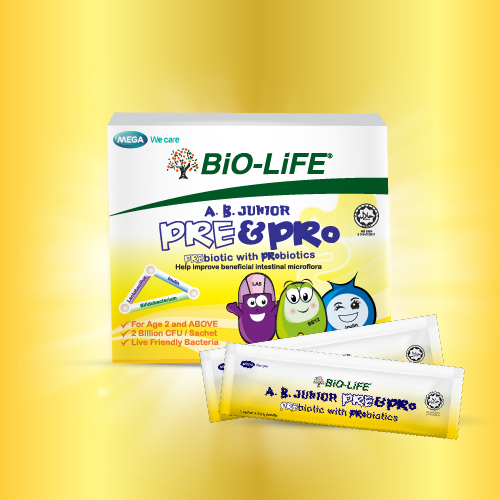

1. A.B. Junior Pre&Pro: clinically tested synbiotic formulation specifically targets children, containing prebiotic: inulin and probiotics: Lactobacillus acidophilus LA53,4and Bifidobacterium lactis BB123,4
Health Benefits: Maintain gut health by stimulating the growth of gut-friendly bacteria, improving bowel movement3,4, and increasing nutrient absorption
Suitable for: Children (2 to 12 years old) who experience hard bowel movements, poor digestion, and appetite
2. A.B. Adult Gold Pre&Pro: clinically tested synbiotic formulation specifically targets senior citizens, containing prebiotic: inulin-oligofructose and probiotics: Lactobacillus plantarum LP015 and Bifidobacterium lactis BB126
Health Benefits: Maintain gut health by replenishing the reduced bifidobacteria, improving bowel movement5,6, and increasing nutrient absorption
Suitable for: Senior citizens (50 years and above) and also adults who suffer from chronic constipation and digestive problems
3. A.B. Imunix: clinically tested synbiotic formulation for adults and children, containing prebiotic: inulin and probiotics: Lactobacillus acidophilus NCFM7 and Bifidobacterium lactis Bl-047,8
Health Benefits: Boost immunity by increasing antibody levels7, reduce risk of URTI (Upper Respiratory Tract Infections)8
Suitable for: Children (2 years and above) or adults with poor immunity, who hope to recover faster from sickness, and easily catch a common cold or flu.
Probiotics are not one-size-fits-all. Different probiotic strains provide different benefits, and your body’s needs may change as you grow older. Because every stage of life has different needs, choosing the right probiotic matters.
References:
- PLoS One. 2022 Aug 3;17(8):e0265288. doi: 10.1371/journal.pone.0265288
- Front Microbiol. 2016 Aug;19:7:1204. doi: 10.3389/fmicb.2016.01204. eCollection 2016
- J Med Food.2011 Jan-Feb;14(1-2):79-85.doi: 10.1089/jmf.2008.0328.
- Int J Food Microbiol. 2011 Sep 1;149(1):50-7. doi: 10.1016/j.ijfoodmicro.2010.12.026. Epub 2011 Jan 15.
- J Clin Gastroenterol. 2010 Sep;44():p S30-S34, doi: 10.1097/MCG.0b013e3181ee31c3
- Br J Nutr. 2015 Sep 18;114(10):1638–1646. doi: 10.1017/S0007114515003347
- FEMS Immunol Med Microbiol. 2008 Jun;53(1):107-13. doi: 10.1111/j.1574-695X.2008.00413.x. Epub 2008 Apr 15.
- Clin Nutr. 2014 Aug;33(4):581-7.doi: 10.1016/j.clnu.2013.10.002. Epub 2013 Oct 10.